DIY Room Cooling Module with PWM Control
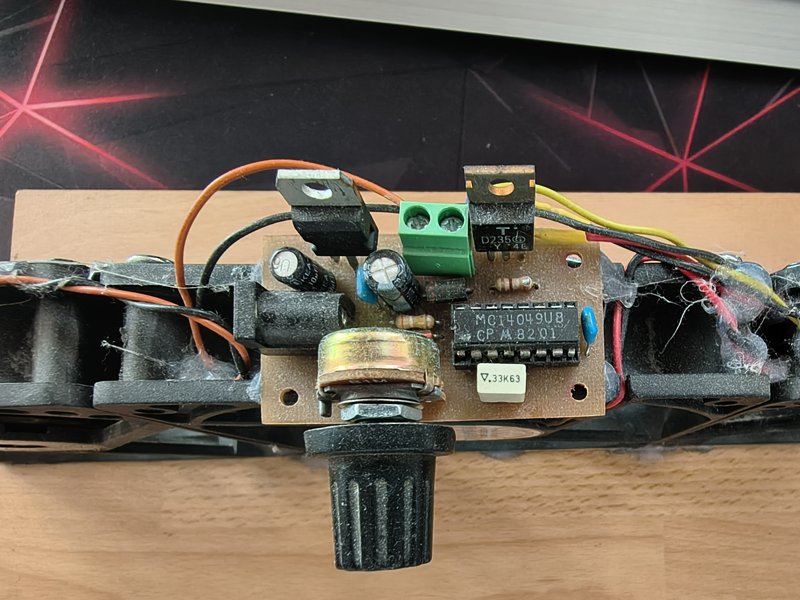
A high-airflow cooling module built from repurposed computer fans, featuring a custom MC14049UB-based PWM speed controller.
1. The Challenge: Beating the Summer Heat
The scorching heat of Summer 2023 challenged me to find a quick and effective cooling solution for my workspace. Rather than purchasing a standard desk fan, I decided to engineer my own high-airflow module by repurposing powerful computer components and designing a custom control circuit.
2. Construction and Design
My goal was to generate a significant airflow in a compact form factor.
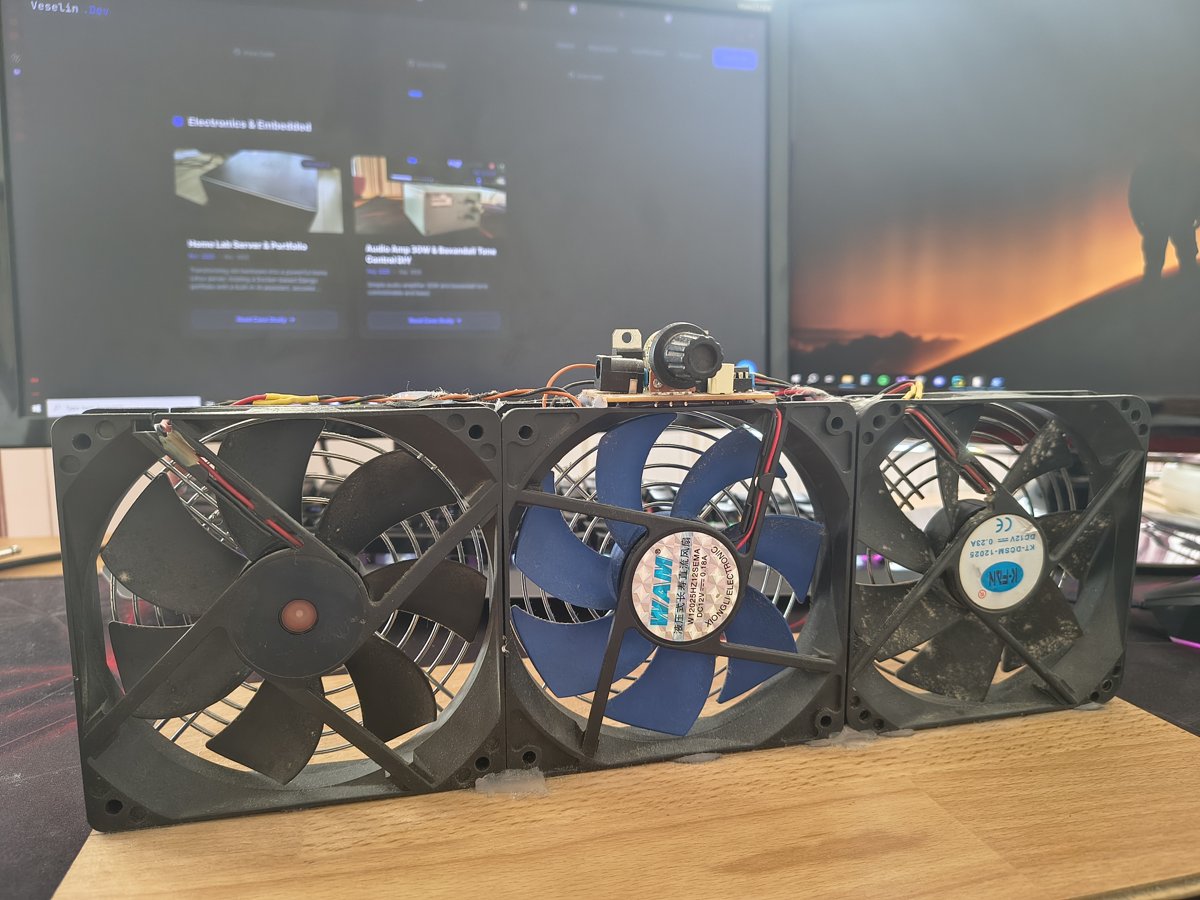
- Unified Block: I combined three large computer fans (120mm) into a single unit.
- Mounting: The fans are mechanically linked and mounted onto a sturdy wooden base, which provides stability and dampens vibrations.
- Power: The system runs on an external 12V source, connected via a standard DC barrel jack mounted directly on the controller board.
3. Electronics: Custom PWM Speed Control
The highlight of this project is the custom speed controller. Instead of using simple voltage regulation (which reduces torque and efficiency), I implemented Pulse Width Modulation (PWM).
- The Brain (MC14049UB): The core of the board is the MC14049UB Hex Inverter/Buffer IC, configured to act as an oscillator. By adjusting the potentiometer, I vary the duty cycle of the signal sending power to the fans.
- Efficiency: The driving transistors operate in switching mode, minimizing power loss as heat. Small heatsinks ensure long-term reliability.
- Smooth Control: This design allows for precise speed adjustment from a silent breeze to maximum airflow.
4. PCB Fabrication
Consistent with my other electronics projects, I wanted a professional finish. I designed the PCB myself and manufactured it using the photoresist method:
- Exposing the photosensitive board through a negative template.
- Chemical etching to remove excess copper.
- Drilling and soldering components for a compact layout that mounts neatly on the fan frame.
Conclusion
Since August 2023, this module has become an essential part of my desk setup. It serves as a great example of upcycling—enhancing standard computer parts with custom analog electronics to solve a real-world problem.
Project Gallery